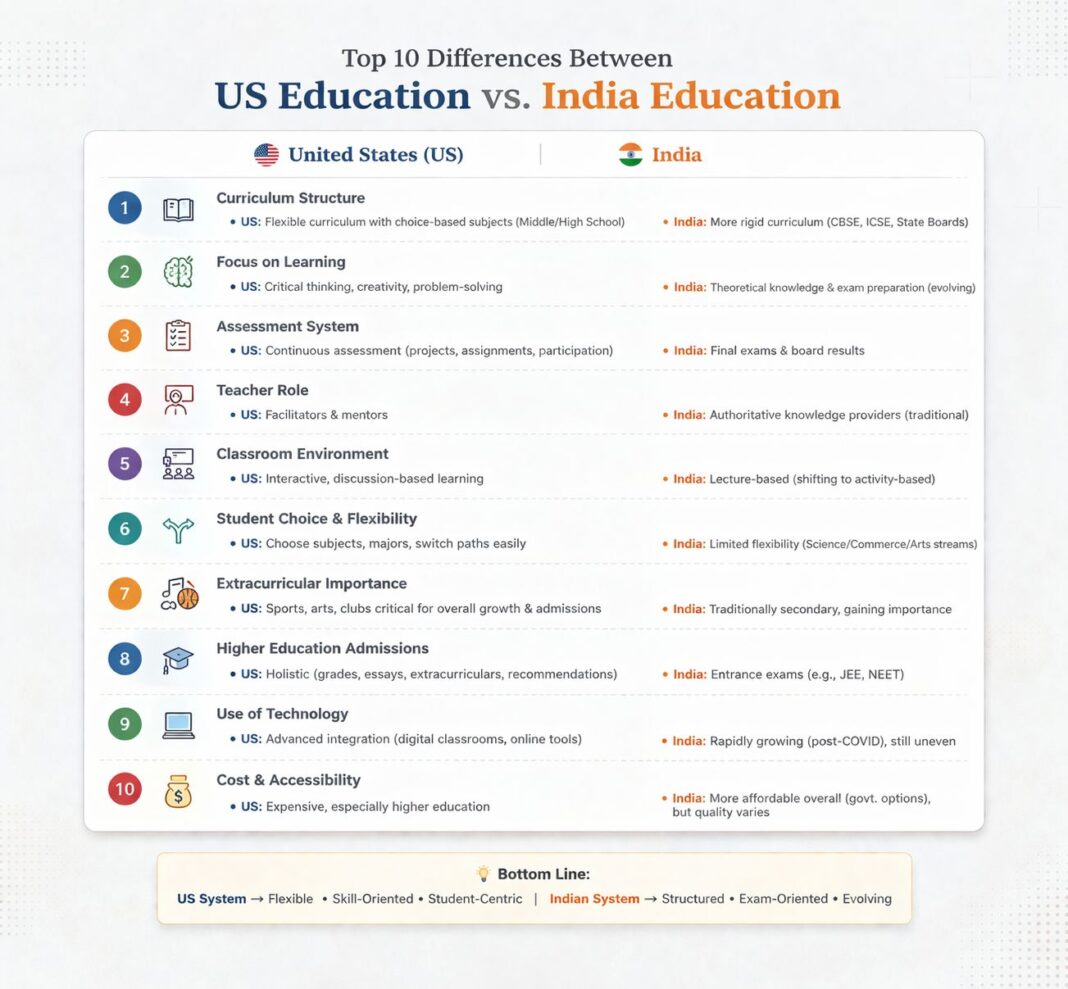

10 key differences between the education systems of the United States and India, explained in a practical, easy-to-understand way:
1. Curriculum Structure
US: Flexible curriculum with choice-based subjects from middle/high school.
India: More rigid curriculum, especially under boards like CBSE and ICSE.
2. Focus on Learning
US: Emphasis on critical thinking, creativity, and problem-solving.
India: Focus is still largely on theoretical knowledge and exams (though changing).
3. Assessment System
US: Continuous assessment (projects, assignments, participation).
India: Heavy reliance on final exams and board results.
4. Teacher Role
US: Teachers act as facilitators and mentors.
India: Teachers are traditionally seen as authoritative knowledge providers.
5. Classroom Environment
US: Interactive, discussion-based learning.
India: Lecture-based, though modern schools are adopting activity-based learning.
6. Student Choice & Flexibility
US: Students can choose subjects, majors, and even switch paths easily.
India: Limited flexibility; career paths often decided early (Science/Commerce/Arts streams).
7. Extracurricular Importance
US: Sports, arts, and clubs are critical for overall development and college admissions.
India: Traditionally secondary, but gaining importance in recent years.
8. Higher Education Admissions
US: Holistic approach (grades, essays, extracurriculars, recommendations).
India: Primarily entrance exams like JEE and NEET.
9. Use of Technology
US: Advanced integration of technology, digital classrooms, and online learning.
India: Rapidly growing, especially post-COVID, but still uneven across regions.
10. Cost & Accessibility
US: Education is expensive, especially higher education.
India: More affordable overall, especially in government institutions, but quality varies widely.
Bottom Line
US system: Flexible, skill-oriented, student-centric.
Indian system: Structured, exam-oriented, evolving toward skill-based learning.